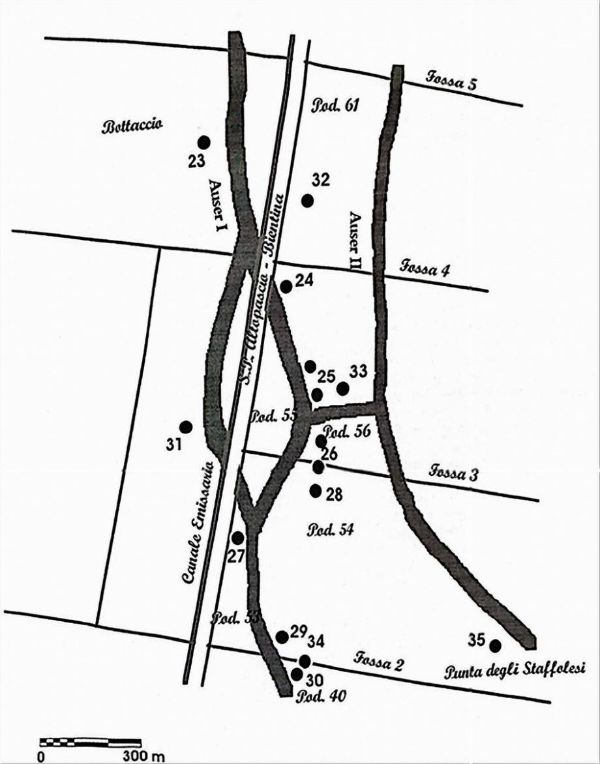
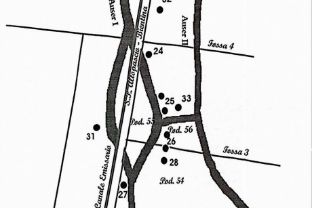
Extensive traces of settlement in the area date back to the period between the early 6th and 5th centuries B.C. The area of Pian di Tiglio seems to have become a widespread settlement of considerable size. Important in this regard were the investigations conducted between 1953 and 1957 between Podere 54 and Fossa 3, which led to the discovery of a dozen incineration tombs of various types: entro dolio and pozzetto. Again in 1957, the area of Podere 56 was investigated, bringing to light the remains of a rectangular dwelling structure with a stone plinth and elevation built en pisèe and a roof of tiles. The settlement had been erected on the river hump of Auser II.
In addition to Isola, the settlement of Fossa 4, explored in two excavation campaigns (1983-1984), is also documented in the Archaic period. During the investigations, traces of huts built around a well emerged. To the same chronology between the 6th and 5th century B.C. belongs the settlement of Fossa 2. The context was explored in 1993, bringing to light the remains of an archaic dwelling made of wood, of which a series of post holes were identified.
Other traces of settlements from the Archaic period are present at Fossa 3, again at Podere 54, between poderi 55 and 56, Podere 53, at Bottaccio where the remains of an Attic kylix appear, at Fossa 4, at Punta degli Staffolesi. Traces of burials attributable to the same period come from Podere 40 and the area of Ex Rio Ponticelli.
Such an articulated and complex panorama makes it possible to define a fairly detailed picture, in which the Ponte di Tiglio area is delineated as a large widespread settlement that arose along the branches of the Auser. An area in which groups of dwellings or small agglomerations, with relative necropolises, alternate with intermediate zones for proximity cultivation, livestock breeding and outdoor domestic activities.
The favourable conditions for the Archaic Age seem to change between the middle and the end of the 5th century BC. The thinning of the population, noticeable with the rarefaction of presences in the area, corresponds to the general crisis of the 5th century B.C., felt in many areas of northern Etruria, caused by socio-political but also natural factors, such as a strong change in climatic conditions. The double burial by incineration with two shafts found in 1929 at Isola di Bientina dates back to this chronological horizon: the container used as a cinerary vessel in the first tomb was an achromatic kelebe of local manufacture; in the second burial, which was almost contiguous, the ashes of the deceased were deposited inside a prestigious Attic goblet crater with red figures, attributed to the workshop of the Meleager Painter and dated around 380 BC. The large crater contains a decoration depicting a scene in which Dionysus and Ariadne are represented between Satyrs and Maenads. The theme of the Dionysian thiasos constitutes a veritable beacon on the beliefs and religious imagery of the last Etruscan communities that populated the area, testifying to the pervasiveness of conceptions linked to mystery rituals and Dionysian saviour cults along the trade routes that distributed the products of Athenian workshops in the northern Tyrrhenian Sea.