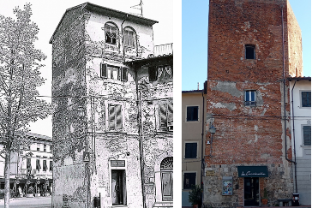
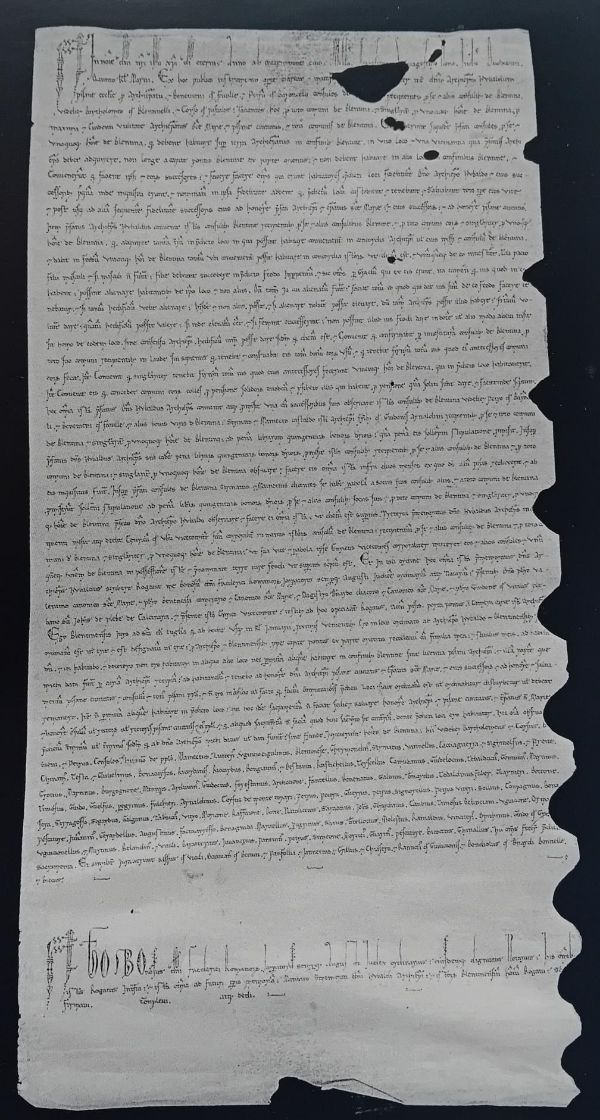
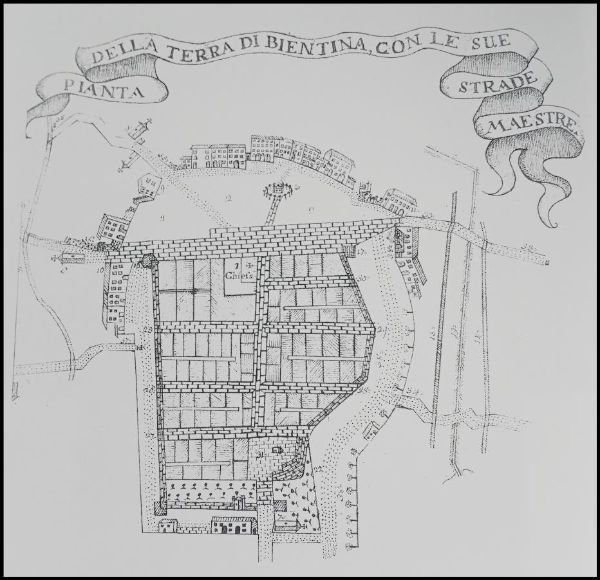
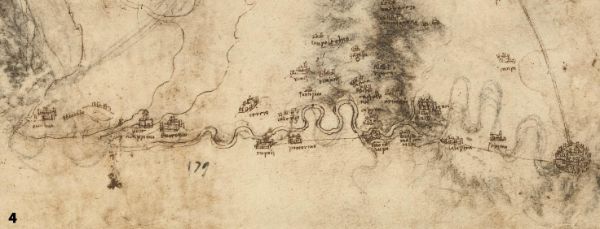
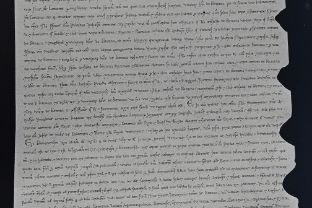
The castle of Bientina, founded in 1179 and completed in 1181 by the bishop of Pisa, strengthened and partly rebuilt in the following centuries by the Pisans, has an irregular plan and preserves a good portion of the southern and eastern perimeter, and three corner towers.
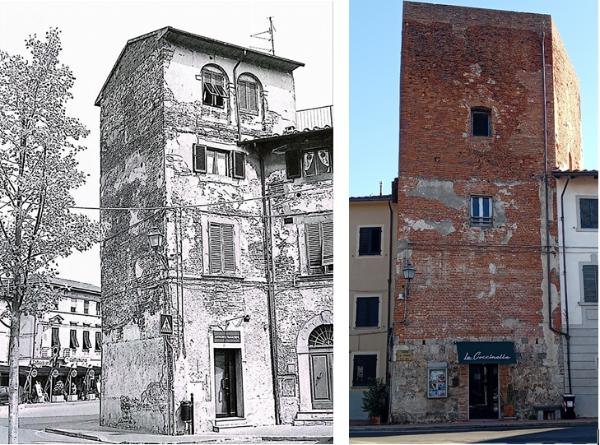
Two towers are pentagonal (Torre della Mora and Torre del Giglio) and one is square (Torre dei Tessitori). A fourth tower (Torre del Belvedere) stood on the site of the present bell tower of the Oratory of St Dominic, at the north-eastern corner of the layout. Inside the walls, in that same corner, is the Rocca or Cassero.
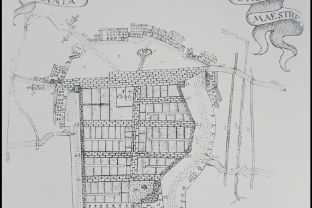
The internal organisation of the settlement drew a regular delimitation of the blocks, obtained by the perpendicular intersection of the three secondary streets (going from north to south) with the main road axis (going from east to west). The boroughs thus obtained had two parallel rows of rectangular residential lots, with the long sides in common with adjacent houses and the short ones aligned along the road and the inner lanes. The main gates were Porta Fiorentina, next to the Rocca, and Porta Pisana on the axis passing alongside the medieval parish church dedicated to St. Mary.
The masonry techniques used in the castle building varied according to the materials used. The structures that are still legible (only some of them are still the original ones from the late 12th century), namely the southern and eastern sections of the walls and the Mora and Giglio towers, were built with a mixed technique using stone and brick. Torre della Mora presents a curtain wall of stone ashlars for a height of approximately 2.5 meters and an exclusively brick masonry in continuity with the successive floors. The same mixed technique is documented in Torre del Giglio (or Torre Imperiale). In that case, the use of stone is minor and reduced to the eastern corner of the structure and only to the exterior elevation, while the interior is built in brick from the ground floor. The same type of masonry has been documented in the remains of Belvedere Tower, brought to light during the construction of the S. Domenico bell tower.
The mixed technique is also confirmed on the east and south sides of the wall circuit. In these, the presence of a stone plinth is evident, formed by at least four rows of ashlars well squared and smoothed on the surface, defining the base for the subsequent brickwork.
The western side of the wall circuit has been modified over time and used as the boundary of the elevations of the buildings facing Piazza Vittorio Emanuele, all of which are now plastered and therefore not readable.
Traces of a facing in phase with the foundation of the castle can be seen in the two main elevations of the so-called Rocca. In the lower part of the masonry, the material used is exclusively verrucano from Monte Pisano, worked in medium-sized blocks, laid in sub-horizontal rows of different heights and bonded with lime mortar. The difference in material used and construction technique with respect to the rest of the tower highlights the presence of remains of older masonry, probably in phase with the time of foundation of the bishop's castle).
Between the 13th and 14th centuries, the castle was refortified several times.
At the end of the 14th century, the defence system of Bientina Castle was reinforced with the construction of Torre dei Tessitori (originally called Torre Mora nuova), with a rectangular plan. This turriform structure differs from the others in the absence of a stone base and therefore the exclusive use of brick.
The last constructive interventions in the defence system of the Bientina castle involved the reconstruction of the fortress in the Renaissance period, in the same place where the keep of the low medieval castle stood.
The masonry technique is very different from those used previously. It is composed of carefully squared stones, made of verrucano, mounted at the corners of the building with the function of cantonments. In the rest of the elevations, brick laid in the Sienese style is used.

%20Comunita%20di%20Bientina.%20Sezione%20D%20del%20paese.%20Antica%20ansa%20dell'Arno%20in%20loc.%20Martraverso~2025-12-29-11-49-09-176~cache.jpg "Catasto Leopoldino")
%20Comunita%20di%20Bientina.%20Sezione%20D%20del%20paese.%20Antica%20ansa%20dell'Arno%20in%20loc.%20Martraverso~2025-12-29-11-49-09-176~cache.jpg "Catasto Leopoldino")